
Nice Kick In the Pants. Video compliments of my brother John.
Nice Kick In the Pants. Video compliments of my brother John.
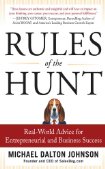
I just finished the “Rules of the Hunt: Real World Advice for Entrepreneurial and Business Success, by Michael Dalton Johnson. I found this book through Jeffrey Gitomer, who wrote the Forward. This is a VERY easy book to read. More of a bullet point approach to practical ideas and strategies. 10 chapters with little pieces of advise from someone with experience. At times it covers pretty basic items, making it a great book for those just starting. At the same time there are advanced tips as well. Here are the items that spoke to me. I highlighted them and pulled them into this blog as a review for myself. It might help you as well. Warning, its long. Here are the points that stood out to me…
Chapter 1, Things they didn’t teach you in Business School:
“Formal education will make you a living. Self-education will make you a fortune.” -Jim Rohn
“A small box of exquisite chocolate truffles is remembered long after a two-pound box of so-so candy. That’s all you need to know.”
Chapter Two, Leadership:
“Don’t tell people what to do; tell them who they are. The most subtle and powerful rule you’ll ever learn for motivating people is to tell them who they are rather than telling them what to do. Example: You’re at the DMV, and you approach the clerk with an exasperated expression. You sigh and say, “This form is confusing; I can’t figure it out.” The clerk looks at you disdainfully and advises you to read the instructions on the reverse of the form, looks past you and says, ‘Next.’ Now imagine approaching the same clerk with the same problem. This time, however, you approach her with a smile and say, “You look like the person who can answer a couple of questions for me about this form.” The clerk smiles back and says, “Let’s see what you’ve got here,” and quickly answers your questions. In the first example, its all about you and your problem. In the second example its all about the clerk. You began your request by telling her who she is by acknowledging her as an expert with the knowledge that can help you. She immediately wants to prove you right and she does.”
“Talent wins games, but teamwork and intelligence wins championships.” -Michael Jordan
“The less detailed, the more empowering. In business, if you are dealing with an experienced and competent associate, abbreviated instructions will sometimes get you the results you are looking for because they also empower the recipient.”
“Set unreasonably high goals for yourself. I subscribe to Fred Bucy’s (former president and CEO of Texas Instruments) law which states, “Nothing is ever accomplished by a reasonable man.” Become unreasonable, come on strong in this area, and have seemingly unattainable dreams. Real progress often depends on unreasonable people. Are your goals unreasonable?”
“Practice creative rule breaking.”
“Hell, there are no rules here – we’re trying to accomplish something.” -Thomas A. Edison
“Be the leader. Its your agenda. Its your business. Its your dream. Its your responsibility. Focus on the goals. Share you vision. Be kind. Communicate clearly. Do the work. Get things done, and get them done today. Maintain your integrity. Set the example. Leave excuses at the door.”
Chapter Three, Relationships:
“Three people you should take to lunch. Invite your banker to lunch. Its best to do this when you don’t need financial services and just want to introduce yourself. Have a friendly conversation. Tell her about your company and your long-term goals. Bankers are great sources of referrals and introductions. They meet a lot of business people. Once they know you, they may send someone in need of your product or service. If the time comes when you do need a loan or bank reference, you have the inside track.”
“Acquire champions. Establish relationships with people like you and who are enthusiastic about what you are doing. This can be almost anybody from your barber to your banker. Champions are a wonderful source of referrals and can expand your business network. If you are dealing with a large, bureaucratic organization, having a champion within the company really pays dividends. Find one. Be inclusive, not exclusive. Imagine having several hundred advocates, some in very high places, who champion your business. This group should include friends, family, vendors, employees and customers.”
“Let’s not do lunch. You’ll get more done over a breakfast meeting, than you will at lunch or dinner.”
“You make a better impression with most people if you are sharply dressed.”
“Do talk to strangers. Talk to strangers? Bad advice for a kid, but good for an entrepreneur.”
“Reach out. What I have long known instinctively was confirmed by Dr. J. Hornick, a researcher at the University of Chicago. He found that a brief light touch on the upper arm of a person you are talking with forms a bond on a subconscious level. It is subconsciously interpreted as an expression of warmth and a friendly desire to bond.”
“Let it be their idea. When discussing an idea, I have found that often it is smart to introduce elements into a conversation that suggest a solution, but I never state the solution. As such a conversation proceeds, the other party will suggest the solution – the one you had in mind all along. At this point, you would be well served by exclaiming, ‘Perfect!’ or ‘Brilliant!’ and consider the deal done. Devious? I don’t know. I’ve been married a long time and have had a lot of experience on the receiving end.”
“Let’s shake on it.”
“I can feel the twinkle of his eye in his handshake.” -Helen Keller
Chapter Four, Strictly Selling:
“Creating excitement and curiosity, identifying a problem, offering a solution, reciting the benefits of ownership, establishing credibility, adding value, up-selling, and ending it all with a strong call to action will close sales for nearly anyone.”
“Learn Telephone 101. Note the phrase ‘I won’t waste your time’ is music to the prospect’s ears. This opening can be adapted to almost any product or service you are selling.”
“This dog won’t hunt. When you are interviewing a candidate for a sales position, always ask, ‘How much money did you make last year?’ If the candidate is shy about talking about a previous year’s earnings, take a pass. If the applicant is shy about talking about money with you, odds are he or she will be uncomfortable talking about money with the prospect. The ideal candidate will introduce the subject and ask, ‘How much can I make?’ within the first 20 or 30 minutes of an interview. If a salesperson is the least hesitant at talking money, she or he is probably not the hungry carnivore you need. This dog won’t hunt.”
“Case histories build confidence with your prospective customers. Make them interesting and demonstrate how a benefit was gained or a problem solved. Include numbers in your case histories. Make them engaging by including before and after stories. Keep them brief. A short paragraph or two for each case history will do.”
“One size does not fit all. If you delivering the same basic pitch over and over, you are undoubtedly losing sales. Take a lesson from the U.S. Marines and ‘improvise, adapt and overcome.’ This requires listening to and reading your prospect. You must always be thinking on your feet and adapting your pitch in real time to what you are hearing from you buyer. It’s no easy feat, but those who master this skill close far more sales than those who don’t.”
“Everybody loves to buy, but nobody likes to be sold. Sales training and motivational legend, Jeffrey Gitomer, has made the above statement famous. It applies not only to selling, but to business in general. If you give people a compelling reason to do business with you, they almost always will. However, it seems to be part of human DNA that if you try to pressure or corner them, they resist it mightily. It’s especially important that everyone selling for your company be aware of this simple but powerful truth.”
“Get emotional. When you are presenting your product or service, do not attempt to appeal strictly to the buyer’s rational mind with a list of perfectly logical reasons to buy. Instead, fire their imaginations and appeal to their emotions. Stress the benefits and rewards of owning your product or using your services. Use colorfully worded illustrations that stress benefits. Sprinkle in some brief case histories. Be likeable. Have some fun. Above all, let the customer do most of the talking. Take the pressure to buy out of the experience, and the successful close will come naturally.”
“What do business buyers want? What does that corporate buyer sitting behind that big mahogany desk really want from you? It’s surprisingly simple: to make their jobs easier, to make them look good to management, to gain respect and prestige, to advance their careers, to be appreciated, to save time, to have some fun and excitement, and to minimize their personal risk.”
Chapter 5, Marketing isn’t Rocket Science…It’s Harder:
“Tell Them 3 Times.
“Repetition makes reputation and reputation makes customers.” –Elizabeth Arden
“Walk Back in History. When a business goes flat, I try to remember a time when business was booming. I re-create everything that was happening at that time in my mind. I’ll even find mailings that we sent out when times were better, and I’ll send one out again. The purpose of that is not to try to re-create the past, but to capture the spirit of a time in the company’s history when things were booming. This exercise gives me ideas for change.”
“The market is interested in benefits, not features. Sell benefits, not features. Even though an army of marketing experts has been giving this advice for years, it has never gained traction. No one is really interested in the fact that your product has a certain feature. People want to know how that feature benefits them. Does it save time or money? Is it fun or entertaining? Does it give them status? Does it simplify or improve their lives? Sell them benefits of ownership, not product features. For example, features of a power mower may be a four-stroke engine, a wider cutting area, and an oversized catch bag. Does that mean longer engine life, less time to spend mowing, and fewer times to empty the catch bag? Say So! Buyers are bored by features and excited by benefits. In sales and marketing the buyer’s emotions come first. So start selling those benefits.”
“Keep it personal. Use the words we, our, us and I sparingly. Your message should be about the reader, not you. This is an especially important rule to follow in the opening paragraph of a letter. By using the word “you” along with their name, a bond is created with readers, and your letter is much more likely to be read in its entirety. Good business communications are friendly and written as if for an intelligent friend. Keep it personal.”
Chapter 7, Working Smarter.
“The person who is waiting for something to turn up might start with their shirt sleeves.” –Garth Henrichs, writer
“Think focus and flexibility. Focus on your goals, but have the flexibility to take advantage of new opportunities. Clarify your vision. Assemble a great support group from outside your organization. Make sure you have a hard-nosed advisor. Don’t get caught up in bureaucratic rules and procedures. Your goal is to grow profits, not paperwork. Get paid faster. Get a discount on everything you buy. Reinvent your business from time to time. Work smarter.”
“Give yourself a job evaluation. From time to time sit down with yourself and review your goals and the progress you’ve made towards achieving them. This should be a more defined and purposeful activity than simple day to day reflection. Set aside 10 or 15 minutes to complete this exercise. Take a look at your numbers. Evaluate your progress. Take a detached look at where you might have bogged down or gone off track, and rethink your strategies. Give yourself a score between 1 and 100. You don’t need to take notes or write a plan. At the end of this exercise you will know what you need to do.”
“Recruit; don’t coach. I enjoy coaching people. It can be very satisfying to see someone increase his or her work skills as a result of coaching. However, recruiting is far more important than coaching. You would be wise to hire people who don’t need extensive coaching. Rewarding as it may be, coaching is not the best use of your time. It’s a false economy to save money on salary by hiring someone without solid experience and then give them on-the-job training. In fact, it’s a strategy that can eat up your time and money and take you away from your primary business goals. If your team needs coaching, it may be cheaper and more effective to bring in an expert and coach from time to time.”
“Expand your vocabulary.
“One forgets words as one forgets names. One’s vocabulary needs constant fertilizing or it will die.” –Evelyn Waugh, author
There is a proven relationship between vocabulary and income. Most successful people have good vocabularies and can express their ideas clearly. Less successful people tend to rely on a limited vocabulary augmented with cliché’s to get their ideas across. You are taken far more seriously when you can express yourself articulately. Clear and precise language gains you respect and credibility. Don’t bother to learn works that are never used in everyday conversation. The fact that you know the meaning of popinjay is not of any value. However, learning one new word a day is money in the bank.”
“As luck would have it… Psychologist Richard Wiseman, the author of The Luck Factor, is one researcher who believes that you can make yourself a luckier person. ‘Lucky people generate their own good fortune via four basic principles,’ he says. ‘They are skilled at creating and noticing chance opportunities, make lucky decisions by listening to their intuition, create self-fulfilling prophesies and positive expectations, and adopt a resilient attitude that transforms bad luck into good.’ In plain talk, Wiseman is saying this: Winners expect to win. They aren’t afraid to play a hunch because they anticipate that luck will reward them. And they look at the bad luck that does, inevitably come their way, as a bump in the road rather than the end of the world.”
“Do not go where the path may lead, go instead where there is no path and leave a trail.” –Ralph Waldo Emerson
“From time to time, personally answer the company phones. Spend an hour answering the phones now and then. You’ll get a good idea of what kinds of calls your firm is receiving. You’ll also gain an appreciation of how tough a job this is. (No, it’s not beneath your dignity.)
“Banish Clutter. I recently read that 90 percent of the time, once a document is put in a file folder, it is never seen again. Get rid of something that isn’t useful, beautiful or joyful.”
“Don’t let work accumulate. Before the advent of the Internet and online banking, I had a friend who would always go to his post office box with a small notebook containing his checkbook and a supply of postage-paid envelopes. He spent a few minutes paying his bills on the spot before leaving the post office. He never took bills home; they never accumulated. So instead of spending a few hours every Sunday afternoon over his bills, he was at the beach. Small tasks that can be handled immediately should not be left to accumulate.”
“Get the right things done. I’ve often heard people who are building businesses say that there are just not enough hours in the day, and they are right. Once you recognize this, you understand the importance of stepping back and focusing on what is important and prioritizing your tasks by asking yourself, ‘What is the best use of my time in growing this business?’ There will always be fires to put out, unforeseen ‘emergencies,’ and minutia to distract you from moving the business forward. The fact is that most of us take on far too much, and there simply is not enough time in the day to get it all done. Make the hard trade-offs for what is going to drive the most value, and put other projects on the back burner.”
“Banish the time bandits. Work eight hours a day. That’s it. The rest of the day is yours. You can get a lot done in eight hours. In fact, eight hours is an eternity. If you don’t believe this, fly coach for eight hours seated next to a crying infant. You’ll get a keen understanding of just how long eight hours can be. Consider the time you devote to productive work as your ‘Golden Eight’ – golden because time is money. Working a solid, focused eight hours is difficult. Every day time bandits knock on your door. Members of this mob include personal calls and texting, bull sessions with co-workers, checking personal email, looking for lost things (highly productive people have clean and well-organized desks), personal errands, long breaks, and longer lunches. The list goes on. It all adds up. Research shows that, on average, salespeople waste two hours a day. This works out to a startling three months a year! How much can you sell in three months? By far the biggest time bandit is the Internet. While the web is indispensable for business, communication, education and research, it is also highly addictive. Like most addictions, it devours your precious time, energy and productivity and, by extension, your income.”
“Each morning take a few moments to write down what you want to accomplish that day. This does not have to be an hour-by-hour work plan. It can simply state the work activities that give you the highest return on your time. Allow yourself a little flexibility, but follow your plan. This will get you on your way to greater productivity. You’ll enjoy the feeling of knowing that you’ve put in an honest and productive eight hours. You’ll look forward with greater appreciation to the sixteen hours left for rest, relaxation, friends, family, and maybe a little time on the internet. I know one entrepreneur who actually has an alarm clock on his desk. After eight hours, the alarm clock goes off, and he goes home. While keeping an alarm clock on your desk may seem a bit extreme (and probably is not necessary for most people), it is a very strong reminder that you have eight hours to accomplish that day’s goals, and as time ticks down, your production goes up as you increase your efforts to reach your goals.”
“Don’t get caught up in office drama. Office drama is not only annoying, but it distracts from work. Try to ignore it because drama decreases in proportion to your disinterest in it. Some people are addicted to drama, and if they can’t find any, they create it to get a fix. If drama is being created continually and becomes a significant distraction, it is time to have a little talk with the offending parties.”
Chapter 8, Gaining Advantages:
“You need racehorses. Your business will struggle if you are working with plodding people who want to collect a paycheck and nothing more. Take your time to find and hire people who see your vision and are ready to work to help you achieve it. The best employees have an entrepreneurial mindset and a winner’s attitude. Interestingly, the challenge and the opportunity are often more important to the right people than the money. If you find such people, get them on your team.”
“Turn overtime into undertime. If a project manager requests overtime, have the requesting party come in to do the work before the start of business rather than stay after hours. It’s simply amazing how this policy cuts overtime expenses to the bone.”
“If you keep telling the same sad small story, you will keep living the same sad small life.” –Jean Houston, American Author
Chapter 9, Avoiding Pitfalls:
“Good things do not come easy. The road is lined with pitfalls.” –Desi Arnaz
“Don’t call without a reason. If you are waiting to hear from someone to move forward with a business deal, do not call that person without a specific purpose. Calls that begin with, ‘I’m calling to check in with you to see how it’s going,’ or ‘We haven’t talked in a while, and I thought I’d just give you a call,’ are perceived by the person for what they are – timid attempts to prod. Such calls are amateurish and put you in a subordinate position – and subordinates are easily dismissed. For the same reason, never thank anyone for taking your call or open with, ‘You’re a hard person to get hold of!’ If it’s time to prod the other person, then prod. You are far better served by being straight to the point by gently asking, ‘How much more time are you going to need to review the agreement and get back to me?’ If this question kills the deal, don’t worry about it. It was never going anywhere in the first place.”
“I have been up against tough competition all my life. I wouldn’t know how to get along without it.” –Walt Disney
Chapter 10, Surviving the Hunt:
Keep it all in balance.
Your Outlook
Be generous with yourself and others.
Dream More.
Don’t compare your life to others. You have no idea what their journey is all about.
Avoid negative thoughts of things you cannot control. Instead invest your energy in the positive present moment.
Don’t overdo. Stay within your limits.
Your Relationships
Each day give something good to others.
Forgive everyone for everything.
Don’t take yourself too seriously. No one else does.
Don’t waste your precious energy on gossip.
Envy is a waste of time. You already have all you need.
Forget issues of the past so it won’t spoil the present.
Don’t remind others of their past mistakes.
No one is in charge of your happiness except you.
Learn a new word every day.
Smile and laugh more.
You don’t have to win every argument.
Taking Care of You
Drink plenty of water.
Eat breakfast like a king, lunch like a prince and dinner like a pauper.
Eat plenty of fruits and vegetables.
Play lots of games.
Read more books than you did last year.
Breathe deeply.
Sleep for seven hours.
Take a 10- to 30-minute walk daily. And smile while you’re walking.
Spend time with people over the age of 70 and under the age of 6.
Keep your sense of humor.
Try to make at least three people smile each day.
What other people think of you is none of your business.
Your job won’t take care of you when you are sick. Your friends and family will. Stay in touch.
Your Life
The worst promise you can break is one made to yourself.
However good or bad a situation is, it will change.
When you awaken alive in the morning, be thankful.
Your innermost self is always happy. Follow it.
No matter how you feel, get up, dress up and show up.
“There is a sense of exhilaration that comes from facing head-on the hard truths and saying, ‘We will never give up. We will never capitulate. It might take a long time, but we will find a way to prevail.'”
— Jim Collins, from his book, Good to Great
Great collection of humans in their peak state. Sports mirrors life. Conquering self is the greatest of accomplishments.
Powerful Poem. I first heard this in the movie, Act of Valor:
“So live your life that the fear of death can never enter your heart. Trouble no one about their religion; respect others in their view, and demand that they respect yours. Love your life, perfect your life, beautify all things in your life. Seek to make your life long and its purpose in the service of your people. Prepare a noble death song for the day when you go over the great divide.
Always give a word or a sign of salute when meeting or passing a friend, even a stranger, when in a lonely place. Show respect to all people and grovel to none.
When you arise in the morning give thanks for the food and for the joy of living. If you see no reason for giving thanks, the fault lies only in yourself. Abuse no one and no thing, for abuse turns the wise ones to fools and robs the spirit of its vision.
When it comes your time to die, be not like those whose hearts are filled with the fear of death, so that when their time comes they weep and pray for a little more time to live their lives over again in a different way. Sing your death song and die like a hero going home.”
~ Chief Tecumseh
Tecumseh (March 1768 – October 5, 1813) was a Native American leader of the Shawnee and a large tribal confederacy (known as Tecumseh’s Confederacy) which opposed the United States during Tecumseh’s War and the War of 1812. Tecumseh has become an icon and heroic figure in American Indian and Canadian history.
Source: Wikipedia.
“Life is a Game of Inches…”
A regular perspective video for me.
“The key to success is for you to make a habit throughout your life of doing the things you fear.”
–Vincent Van Gogh (1853-1890) Dutch painter first career: art salesman
Morning Juice, 07-26-2012
I “shared” the article. I also posted below. What is it? I subscribe to Ace of Sales (www.aceofsales.com), which is a great marketing, branding and communication tool, with a basic CRM capacity. If you receive my Morning Juice, you get it from Ace of Sales.
Periodically they share articles to help market and more importantly brand yourself. Loved today’s tip:
It’s the middle of summer. Your vacation starts tomorrow. Time to turn on your “out of the office” auto-reply.
Yours might sound like this:
“I’m on vacation until August 6th. If you need anything before I return, contact my assistant at 800-555-1234 or by email at assistant@ourcompany.com. I’ll respond to your email as soon as I’m back.”
Short. Sweet. Perfect, right?
Well… it doesn’t make much of an impression, does it?
No. But who cares? After all, you have a million things to do before your minivan pulls out of the driveway.
Using a creative “out of the office” auto-reply message is a fast and often overlooked opportunity to stand out from competitors, strengthen your brand, build a little loyalty, and offer some value to customers while you’re sipping umbrella drinks under a grass hut.
It’ll only take you 5 minutes if you just remember the “3 keeps” – keep it short, keep it fun, keep it real.
1. Tell them where you’re going. You’re out of the office – great! So where are you? Tell them. It’s far more interesting than saying you’re not there. It’s a golden chance to connect and prepare your customers for a conversation when you return. Your auto-reply could go like this, “I’m vacationing in Bermuda with my 3 kids – my ‘Bermuda Triangle.’ Unless my plane is sent back in time, I’ll be back in the office Monday, August 13th.”
2. Tide them over with something valuable. “I’m out of the office, but before I left I found this short article you’ll love – ’7 ways to make your home 25% more energy efficient without buying a thing.’ Let me know what you think. I’m back in the office next week!” It could be an article, video, blog post, news story, or anything your customers would perceive as valuable. It proves you thought about them before you left.
3. Make ‘em laugh (or at least smile.) Your personality is a big plus to your customers and a major reason why they work with you – they like you! Don’t disrespect and disappoint them by using a template “out of the office” reply devoid of “you-ness.” “I’ve traded in my suit and tie for the week for my swim trunks and beach shirt. That’s right, beach shirt – I have body issues. Greetings from the Outer Banks! I’m back Monday.” Or, “Who cares where in the world Carmen San Diego is – I’m jumping wakes on my wave runner on Lake Michigan. Where am I on Monday? Responding to you back in my office.”
4. Be more specific. If the playful or creative route doesn’t suit you, use your auto-reply as a chance to give the emailer more information and a response expectation. “I’m on vacation, but I see you’re at work. I’m back Monday and will mostly be using that day to catch up. My goal is to respond to everyone by Tuesday at noon. If you need me quicker, just call: 434-555-1234!”
5. Introduce your back up. Your customers know you and love you, but they may not know your assistant or support person who will be on point while you’re catching rays. By introducing your back up in a fun and personal way, your customers will be more comfortable (and more likely) to use the back up and get the help they need. “Lucky for you, I’m in Cabo for the week. Why lucky? Because that means you get to work with Sally Iver, my fellow consultant who’s filling in for me while I’m away. She loves chocolate, tennis, and making customers happy. Customer, Sally. Sally, customer. Back at my desk on Monday!”
6. Allow them to connect, while you’re away. “Thanks for your email. I’m in Las Vegas on vacation. But what happens on my trip, isn’t staying in Vegas. I’m tweeting and blogging ideas for you to help your business grow and a few personal things mingled in – Uh, oh! Follow me @andyhorner and andyhorner.com.” Post at least 1 blog post per day and 2-3 tweets. Make sure they’re rich with value and watch your followers grow while you’re away.
Bonus: Don’t use an auto-reply at all. Have a support person or assistant reply to your emails or just respond to them yourself once a day while on vacation. Now that’s out of this world! It also makes for less catch-up work for you when you return.
What’s the best auto-reply you’ve ever used or seen? Leave it in the comments below!
“May you have the hindsight to know where you’ve been, the foresight to know where you’re going, and the insight to know when you’re going too far.”
— Irish Blessing
 Burn the Boats!